Talking about the past can be pleasantly nostalgic. Complaining about the present is a national pastime. But talking about the future? Well, that’s a harder task altogether.
The uncertain nature of the future makes it hard to imagine how life might change over the coming decades, let alone the next century. Yet, if the future is something we can collectively shape then everyone should have opportunities to imagine it.
As part of Rutherglen 900: Making Futures, a year-long festival celebrating 900 years of Rutherglen, we invited the people of Rutherglen (known as “Ruglonians”) to do just that by creating Postcards for the Future: messages, drawings, and reflections addressed to the town 100 years from now.

The Postcards for the Future event formed part of Striding the Streets, a revival of a historic community parade celebrating Rutherglen’s 900th anniversary. The parade saw a procession of children, adults, travelling musicians, giant horse puppets, and the town’s mascot, Dougie the Pigeon, make their way through Rutherglen before culminating in the park where the W/L/F team invited residents to stop by our stall and imagine Rutherglen in the year 2126.
Imagining Rutherglen in 2126
In Overtoun Park, Melanie, Susan, and I ran an activity tent where adults and children could write or design a postcard imagining the future of Rutherglen 100 years from now. We offered two kinds of postcard, a traditional picture postcard and a blank draw-your-own-design card, and invited Ruglonians to consider questions such as:
- What would Rutherglen look like in 2126?
- What message would you leave for future generations?
- What new parks, buildings, or community spaces would exist?
- What should future residents remember about life today?
Children took to the drawing prompts, opting to design their own postcards filled with images of future buildings, technologies, landscapes, and animals, while adults preferred to write on the traditional postcards.

The postcard format offered a simple and accessible way into thinking about the future. While we constantly make plans for tomorrow, next year, retirement and all forms of future-thinking, imagining life a century from now can feel abstract. Creative activities such as drawing, writing, storytelling, and crafting can help people approach the future indirectly. Rather than asking residents to produce a detailed vision or prediction, creative prompts encourage imagination, speculation, and reflection letting people think with their hands as well as their heads.
For some participants, writing a message to future generations prompted reflection on what matters most now. For others, especially children, drawing opened possibilities that might have been difficult to express in words. Flying cars, future wildlife, new community spaces, and restored landmarks all emerged through drawing.
While the postcards can’t predict what Rutherglen will become, they reveal the hopes and aspirations that residents carry into their visions of the future.
What People Shared
We gathered up around 70 postcards during Striding the Streets, and we are grateful to every resident who came to talk with us, draw, or write a postcard amidst the fun of the festival. Reviewing the postcards we saw that the cards captured people’s hopes and fears around community life, environmental change, heritage, technology, and public space, with several themes appearing repeatedly.
The Importance of Community Landmarks
One landmark came up again and again in postcards and conversations: Rutherglen’s bandstand.
Built in 1914, and currently residing in Overtoun Park, Rutherglen’s bandstand holds a special place in local memories. Generations of Ruglonians have associated it with music, community events, celebrations, and everyday encounters. Although years of neglect, followed by a devastating fire, left the structure in a state of disrepair, its future now looks much brighter. Restoration work is underway, helping to ensure that the bandstand remains part of Rutherglen’s landscape for generations to come.
Postcards about the bandstand focused on it being fixed, revealing something important about how people think about the future. Future visions are rarely detached from the past. Instead, residents often imagined a better future through the preservation and renewal of places that already matter.
The bandstand is a powerful example of what we could call a community materiality: a place-based object that collects and holds local memories and emotions. The desire to see it restored was not simply about protecting a piece of heritage. It was about ensuring that future generations inherit a place that continues to bring people together.

Reimagining Main Street
Another recurring theme was the future of Rutherglen’s Main Street.
The town’s historic markets and horse trading shaped the distinctive wide high street that many residents still view as one of Rutherglen’s defining features. Older residents recall stories from their parents in which Rutherglen was a bustling centre and a destination whose many cinemas drew visitors from far beyond the town. A walk down Main Street once meant inevitably bumping into this or that neighbour or friend. As one resident wrote, “I would like to see a return to a busy Main Street which would be the centre of the community.”
These memories speak to concerns, felt all over the UK, about the decline of high streets. But they are about far more than nostalgia. Residents desire Main Street to once again act as a centre for social life, and their future visions, while not tied to entirely new possibilities, centre around recovering and adapting Main Street. Residents wish to restore lost opportunities for connection which are critical to human flourishing.

Environmental Futures
Environmental themes appeared regularly too.
Residents imagined a greener Rutherglen, with lakes, trees, renewable energy, and thriving wildlife. One postcard, signed by a child and his father, expressed a simple hope: “I’d like to see a small lake and for the library to still be here.”
Wildlife restoration also came up. One resident simply wrote: “More otters please!” Yet this was not only a wish for the future. Her postcard also celebrated the otters that have already begun returning to the Clyde after decades of decline caused by pollution and habitat loss. She encouraged present-day Ruglonians to look for them near Strathclyde Park and along the Clyde and Kelvin at dawn or dusk.
Taken together, these postcards suggest that environmental futures are not always imagined through technological breakthroughs or grand climate solutions. Instead, many envisioned a future shaped by care, stewardship, and ecological restoration. Their visions focused on recovering and nurturing the landscapes, waterways, and wildlife that make everyday life richer, healthier, and more connected to place.
Libraries, Galleries and the Future of Local Culture
Many participants imagined a future Rutherglen with stronger community spaces: places where people could learn, create, meet others, and spend time together outside of home, work, or school. Among the collected postcards, cultural and educational spaces were particularly important to younger residents.
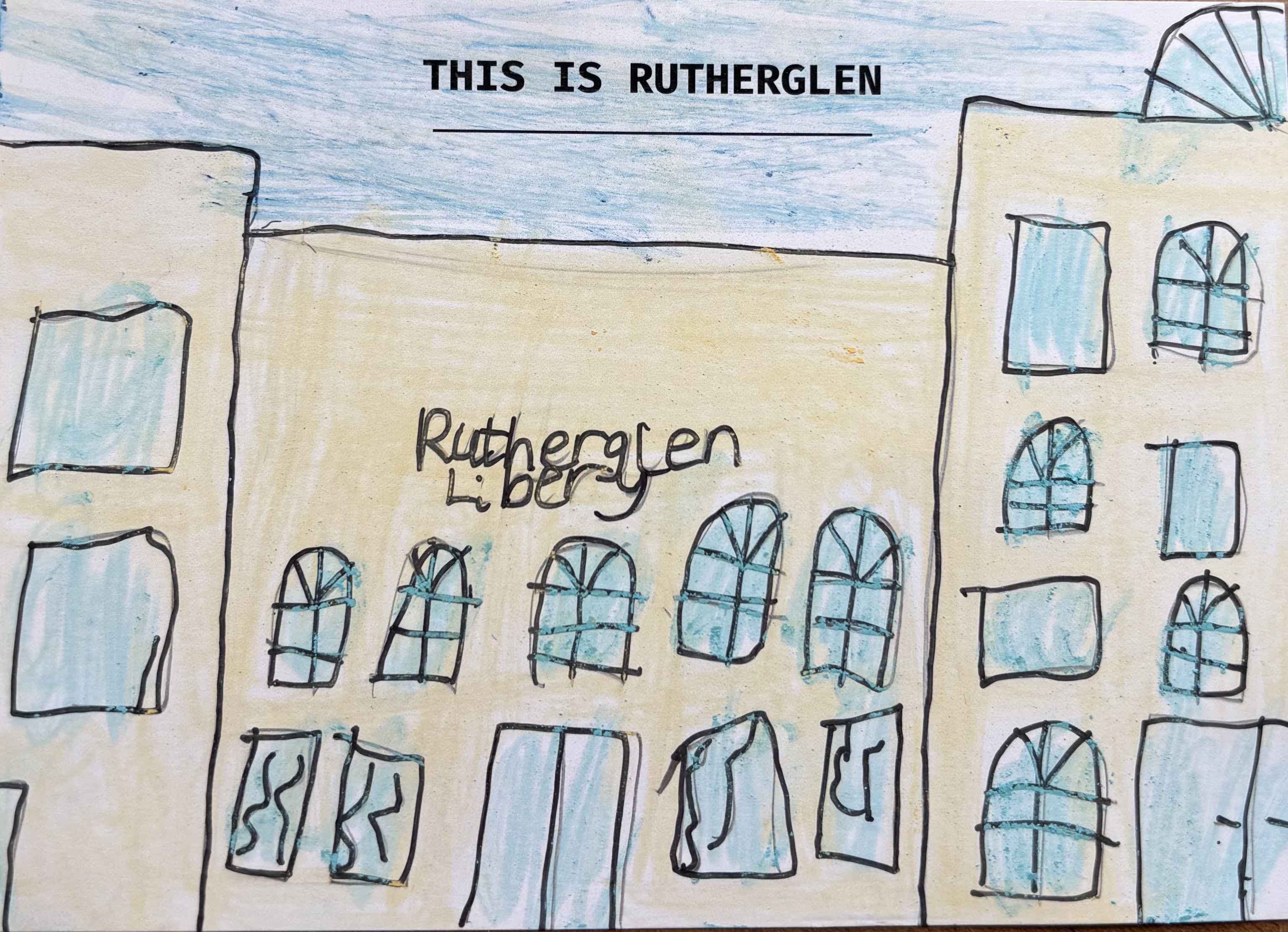
One of the most memorable contributions was a drawing of Rutherglen Library. A young girl had devoted considerable time and effort to depicting the building and explained that it was important to her that future generations continued to have access to the library. She loved reading and believed that reading would always be important.
Another child imagined a future art gallery for Rutherglen. Their postcard envisioned a community where the arts were visible and valued parts of everyday life.

Together, these drawings suggest that young people do not imagine the future solely in terms of new technologies or futuristic transport (though hovercars featured in plenty of postcards). They also imagine futures built around spaces that value learning, imagination, and creativity.
These postcards highlight the importance of what sociologists call third spaces: places that are neither home nor work, where people can gather, participate in community life, and form social connections. Libraries and galleries perform these roles while also supporting cultural and educational opportunities across generations.
What is striking about these future visions is their emphasis on continuity rather than radical transformation. Neither child imagined a completely different world. Instead, they imagined a future in which access to books, knowledge, and art remain available to everyone.
Viewed in this way, the library and gallery represent aspirations for a future community that continues to invest in learning, imagination, and shared cultural life.
Aliens, Spaceships, and Rutherglen
As the day went on, our line displaying the postcards filled with bright crayon illustrations of flying saucers and little green aliens.
At first, I dismissed these as the all-too-familiar imagery of science fiction and the optimism of the Space Age and moon landings. Yet the more I reflected, the more these drawings seemed to capture something important about the present as well as the future and to show a contrast between how children and adults imagine the future.
While many adults focused on restoring landmarks, revitalising Main Street, or strengthening community life, younger participants imagined futures that stretched beyond the Earth itself. Their drawings reflected a world in which space exploration is no longer confined to science fiction but is becoming an increasingly visible part of public discussion.
These postcards raise an important question: if space is becoming part of our collective future, who gets to imagine and shape that future? Decisions about space exploration are often concentrated within governments, military organisations, and a relatively small number of powerful technology companies. Yet the social, environmental, and ethical consequences of those decisions will affect everyone.

These drawings served as a reminder that conversations about the future should not be limited to experts, policymakers, or tech-entrepreneurs. Children in Rutherglen are already imagining humanity’s relationship with space, and if we are serious about building democratic futures, then conversations about space should be just as open to communities, families, and young people as conversations about local parks, libraries, or high streets.
Perhaps most importantly, these aliens and spaceships expanded the scale of the conversation. While many postcards asked what Rutherglen might look like in 2126, these drawings invite a much bigger question: what kind of future do we want humanity to create, both on Earth and beyond it?
Looking Forward by Looking Back
The most striking finding was that people rarely separated the future from the past.
Whether discussing the bandstand, Main Street, libraries, wildlife, or community spaces, residents imagined futures built on the preservation, renewal, and reinterpretation of things they already valued. The postcards suggest that Ruglonians often imagine the future not as something entirely new, but as something repaired, restored, and cared for. A restored bandstand. A thriving Main Street. Returning otters. A library still open for future generations. These were not visions of radical transformation so much as visions of continuity, stewardship, and collective care.
In Doctor Who (a British science-fiction show), Scotland’s David Tennant described time not as linear but as “a big ball of wibbly-wobbly, timey-wimey stuff.” The postcards suggest that future imaginaries operate in much the same way. Visions of 2126 were rarely detached from the past; instead, memories, heritage, and contemporary concerns flowed into hopes for what Rutherglen might become.
This challenges a common assumption that thinking about the future is primarily about technological innovation or dramatic social change. While flying cars, spaceships, and little green aliens made an appearance, most local people grounded their hopes for the future in the places, relationships, and institutions that matter today.
By inviting residents to send a message to 2126, we gained insight not only into the futures they hope for, but the meaningful past and present. These postcards offer a simple but important reminder: imagining the future is not only about radically envisioning what comes next but imagining future and present acts of preservation, restoration, and care.
Leave a Reply